The compensation would be met through levy of a cess called 'GST Compensation Cess' on luxury items and sin goods like tobacco, for the first five years.

'Ek baar aap GST dekh lo!' - Prime Minister Narendra Modi's gentle nudge to Finance Minister Nirmala Sitharaman in December last year sparked the beginning of a mammoth exercise to overhaul the tangled goods and services tax regime. And the final outcome is a significantly simplified system with lower tax rates and easier compliance for businesses.

To ensure a glitch-free rollout of the next-generation GST with reduced rates and lesser slabs, Finance Minister Nirmala Sitharaman chaired three separate meetings to assess GSTN's preparedness and the time it would take to implement technological changes required in the software systems.

Two-wheeler sales volume is expected to grow 5-6 per cent this fiscal, while that of passenger vehicles to see a 2-3 per cent rise, following the GST rates rationalisation on automobiles, according to Crisil Ratings. The GST Council's decision to move to a two-rate structure of 5 per cent and 18 per cent, effective September 22, 2025, is a timely move that will revive demand for automobiles, Crisil Ratings said in a statement.
The Centre managed to collect only Rs 990 crore as compensation cess in April 2020-21, almost one-ninth of the figure of Rs 8,874 crore mopped up a year ago. The subdued collection would further increase states' problems unless the GST Council, which meets next week, decides to borrow from the market.

As of now, no firm has launched a flex-fuel vehicle in India, as these models are more expensive than comparable petrol-run vehicles.

The proposed 'Next Gen GST' with sweeping reforms, lower tax rates, and just two slabs, aims to boost the economy amid tariff threats and set the stage for a single tax rate regime by the time India becomes a developed nation, government sources said.

Simplifying GST rates, removing exemptions, easing disputes, and speeding up refunds can boost investment in India and offer the best reply to Trump's tariffs, observes V S Krishnan, former member, Central Board of Indirect Taxes and Customs.

http://im.rediff.com/money/2023/jul/20uv.jpg
It is likely to be a stormy affair with divergent views on market borrowing. Centre will likely press states to borrow to make up for the shortfall, but states want either the Centre or the GST Council to do so.

While Congress and the states ruled by non-NDA parties pushed for the Centre meeting its statutory obligation of covering the deficit, the Union government cited a legal opinion to say it had no such obligation if there was a shortfall in tax collections. The Centre as well as BJP-JD-U-ruled Bihar were of the opinion that the states should borrow to make up for the shortfall in the tax revenues that have been compounded by the COVID-19 crisis, sources said.

The GST Council on Saturday postponed a decision on cutting tax rate on life and health insurance premiums, officials said. The 55th meeting of the GST Council, chaired by Union Finance Minister Nirmala Sitharaman and comprising state counterparts, decided that some more technicalities needed to be ironed out and tasked the GoM for further deliberations.

The question on who should borrow from the market and whether the borrowing will be under two buckets should be decided by the GST Council, and not by the Centre. If there is no consensus, there has to be a vote, says A K Bhattacharya.
Gross GST collections rose by 9.1 per cent to about Rs 1.84 lakh crore in February, boosted by domestic consumption and indicating potential economic revival. As per the official data released on Saturday, on a gross basis, mop up from Central GST stood at Rs 35,204 crore, State GST at Rs 43,704 crore, Integrated GST at Rs 90,870 crore and compensation cess of Rs 13,868 crore.
The 41st meeting of the GST Council, to be held via video conferencing, has just one agenda for discussion -- making up for shortfall in states' revenues, sources said.

Amid the impending rejig in the goods and services tax (GST) rates, an association representing the country's beverages industry has appealed to the Centre to not classify aerated beverages as sin/demerit good and bring it under the 18 per cent slab while citing their "mass consumption" as a reason.

The October 5 meeting assumes significance as the Centre and states are at loggerheads over the issue of funding Rs 2.35 lakh crore GST collection shortfall.
Some states are taking a legal view on the state GST rate and the compensation rules ahead of the Goods and Services Tax (GST) Council meeting, which is likely to be held in mid-June, said people in the know. While the agenda is still being finalised, several states are likely to take up the matter related to GST compensation and may pitch for its continuation beyond the June 30 deadline. States would like to know how they would divide the compensation collected after June 2022 for payment of principal and interest of compensation shortfall borrowing and arrears to states, sources said.

A road map could be laid out for a gradual reduction in the tax rates from the current incidence of about 62-94 per cent without causing a major blow to the revenues of the Centre and the states. The opportunity arising out of higher GST collections should not be squandered, says A K Bhattacharya.

The finance ministry on Monday said it will transfer Rs 6,000 crore as the second tranche of GST compensation shortfall to 16 states and 3 Union Territories -- including Maharashtra, Bihar, Assam, Puducherry and Delhi. The Centre had on October 23 transferred Rs 6,000 crore to 16 states and 2 UTs of Delhi and Jammu and Kashmir. In the second tranche of transfer, Union Territory of Puducherry has been included.

'States should be compensated for the revenue loss for at least five years or beyond till the revenue stabilises.'
Even with the Rs 20,000 crore distributed among states, it will still be a fraction of what they have been demanding in financial support and clearance of pending dues.
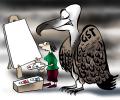
Experts said if the slowdown, and subsequent weakness in GST mobilisation, continued, it would curtail the Centre's resources to a considerable extent in the current financial year.

The stalemate over compensating states for the shortfall in GST collections continued on Monday with a meeting of the GST Council ending without reaching any consensus. The panel, which is the highest decision-making body on indirect taxes, for the second time in a week failed to reach a consensus on the Centre's proposal of states borrowing against future GST collections to make up for the shortfall.
Goods and Services Tax (GST) collections in September, in gross terms, were at Rs 1.73 lakh crore, with a yearly jump of 6.5 per cent, according to data from finance ministry released on Tuesday. In September 2023, the total collection was to the tune of Rs 1.62 lakh crore. CGST, SGST, IGST, and cess all increased year-on-year in September, official data made available on Tuesday showed.
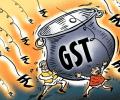
The shortfall in the Centre's GST collections has raised concerns over it meeting the fiscal deficit target of 3.3 per cent of GDP, reports Ishan Bakshi.

The object of the government policy cannot be such that luxury items become cheaper, pointed out Jaitley.

While Union Finance Minister Nirmala Sitharaman reiterated her stand that the central government was committed to cooperative federalism, finance ministers of non-BJP ruled states such as Punjab and Kerala said she refused to give a categorical assurance that states will be paid compensation on time.
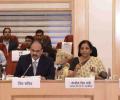
After the GST Council's meeting in March, the Centre had sought views from Attorney General K K Venugopal -- who is the chief legal officer of the government -- on the legality of market borrowing by the council to make good any shortfall in the compensation fund. The AG in his view said there is no obligation on the central government to pay the GST compensation shortfall, according to the sources.

The Budget should use the extra RBI surplus to better effect, suggests A K Bhattacharya.

The Central government will borrow up to Rs 1.1 lakh crore on behalf of the states to bridge the shortfall in GST collections, the finance ministry said on Thursday. A slowdown in the economy since last fiscal has resulted in a drop in the Goods and Services Tax (GST) collections, upsetting the budgets of states which had given up their right to levy local taxes such as sales tax or VAT when GST was introduced in July 2017. To make up for the shortfall, borrowing from the market was proposed.

Dissenting states including Chhattisgarh and Kerala, have made it clear they are in no mood to relent. They want the Centre to borrow the entire Rs 2.35 trillion this fiscal citing bleak fiscal position.
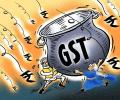
GST collections in July rose 10.3 per cent to over Rs 1.82 lakh crore, mainly driven by domestic transactions in goods and services, according to official data released on Thursday. This is the third-highest-ever monthly collection recorded since the indirect tax regime was rolled out 7 years ago on July 1, 2017. According to the data, total refunds stood at Rs 16,283 crore in July.

The all-powerful GST Council on Friday decided to charge food delivery platforms such as Swiggy and Zomato a tax even as it extended concessional tax rates on certain COVID-19 drugs by three months till December 31. The Council, which comprises the Union finance minister and her state counterparts, decided to continue keeping petrol and diesel out of the GST purview as subsuming the current excise duty and VAT into one national rate would impact revenues. Briefing reporters on the decisions taken by the Council at a meeting here, Union Finance Minister Nirmala Sitharaman said GST has been exempted on muscular atrophy drugs like Zolgensma and Viltepso, which cost crores of rupees.
No longer a discretion of the tax administrator, the audit of returns filed by taxpayers is now based on a selection by algorithms, notes Tarun Bajaj.

The 14th Finance Commission had recommended that states' share in the divisible tax pool be raised to 42 per cent, from 32 per cent earlier.
India's GST collection remained above Rs 1 lakh crore for the third month in a row at over Rs 1.17 lakh crore in September, raising expectations that second half of the year will post higher revenues. The tax collections in September on goods sold and services rendered was 23 per cent higher than Rs 95,480 crore collected in September 2020, and 27 per cent higher than Rs 91,916 crore collected in September 2019. The collection in September is the highest in five months since April, when revenue was at record high of Rs 1.41 lakh crore.

The central bank is the money manager of the government, and not a guarantor of any debt.
For 2019-20, the government proposes to collect Rs 6.10 lakh crore from CGST and Rs 1.01 lakh crore as compensation cess.

Equity markets will take cues from the US tariff related developments, global trends and trading activity of foreign investors this week, analysts said.
 © 2026 Rediff.com - Investor Information - Advertise with us - Disclaimer - Privacy Policy - Sitemap - Feedback - About us - Terms of use - Grievances